Last Updated: August 3, 2026
Quick Answer: Copyright protects original creative expression (writing, music, art, software code) and exists automatically the moment the work is fixed in tangible form. A patent protects inventions (how something works or how it looks) and only exists if you apply for one and the USPTO grants it. They cover different things, they cost different amounts, and many products need both. As a starting point, functional inventions point you toward a patent and expressive works point you toward copyright, but most modern products (software especially) contain some of each, and that overlap is where people most often choose wrong.
If you’ve created something valuable, the question isn’t really “what’s the difference between copyright and patent?” It’s “which one do I need, and what happens if I pick wrong?” That’s the question we help founders and inventors answer at Schell IP every week, so let’s answer it properly.
What a Copyright Protects
Copyright covers original works of authorship recorded in a fixed form: books, music, photographs, artwork, films, and the expressive parts of software. According to the U.S. Copyright Office, copyright protects the way ideas are expressed, but never the ideas, systems, or methods themselves.
Two things make copyright unusual among IP protections. First, it’s automatic. The moment you write the novel or record the song, you have common-law copyright rights, though registering with the Copyright Office is what gives you the ability to sue for statutory damages. Second, it’s long. Protection typically lasts the life of the author plus 70 years, which is more than three times the life of a patent.
What copyright will not do is protect function. You can copyright the source code of your app, and a competitor may be able to still legally build an app that does exactly the same thing with different code. That gap is where patents can often help.
What a Patent Protects
A patent protects an invention: a new and useful process, machine, article of manufacture, or composition of matter (a utility patent), or the ornamental appearance of a product (a design patent). Unlike copyright, patent rights don’t exist until you apply and the USPTO grants them, and the application has to prove your invention is new and non-obvious.
A utility patent lasts 20 years from the filing date, subject to maintenance fees. A design patent lasts 15 years. In exchange for that shorter, harder-won protection, you get something copyright can never give you: the right to stop anyone from making, using, or selling the invention itself, even someone who developed it independently and never saw your work.
At Schell IP, we tell clients to think of it this way: copyright protection can create consequences for someone who copies something you authored, while a patent can create consequences for someone who launches a competing product with your patented invention, even if they arrived at it on their own without necessarily copying. That difference is why patents generally cost more, take longer, and are usually the more valuable asset when a startup gets acquired.
Copyright vs. Patent: The Key Differences at a Glance
- What’s protected. Copyright covers expression: the words, images, sounds, and code as written. A patent covers function or design: what the thing does or how it looks. Neither protects a bare idea sitting in your head.
- How rights arise. Copyright is automatic on creation, with registration as an inexpensive upgrade. A patent requires a formal application, examination, and grant, which is why working with a patent attorney is critical especially on the patent side.
- How long they last. Copyright: life of the author plus 70 years. Utility patent: 20 years from filing. Design patent: 15 years from grant.
- What they cost. Copyright registration is generally in the hundreds of dollars of fees and does not require an excessive amount of attorney time. A patent is a four- to five-figure investment; our complete patent pricing guide breaks down exactly where that money goes.
- Disclosure. A patent application discloses your invention to the public in exchange for protection. Copyright requires no disclosure at all, which is why some companies protect certain methods as trade secrets instead of patenting them.
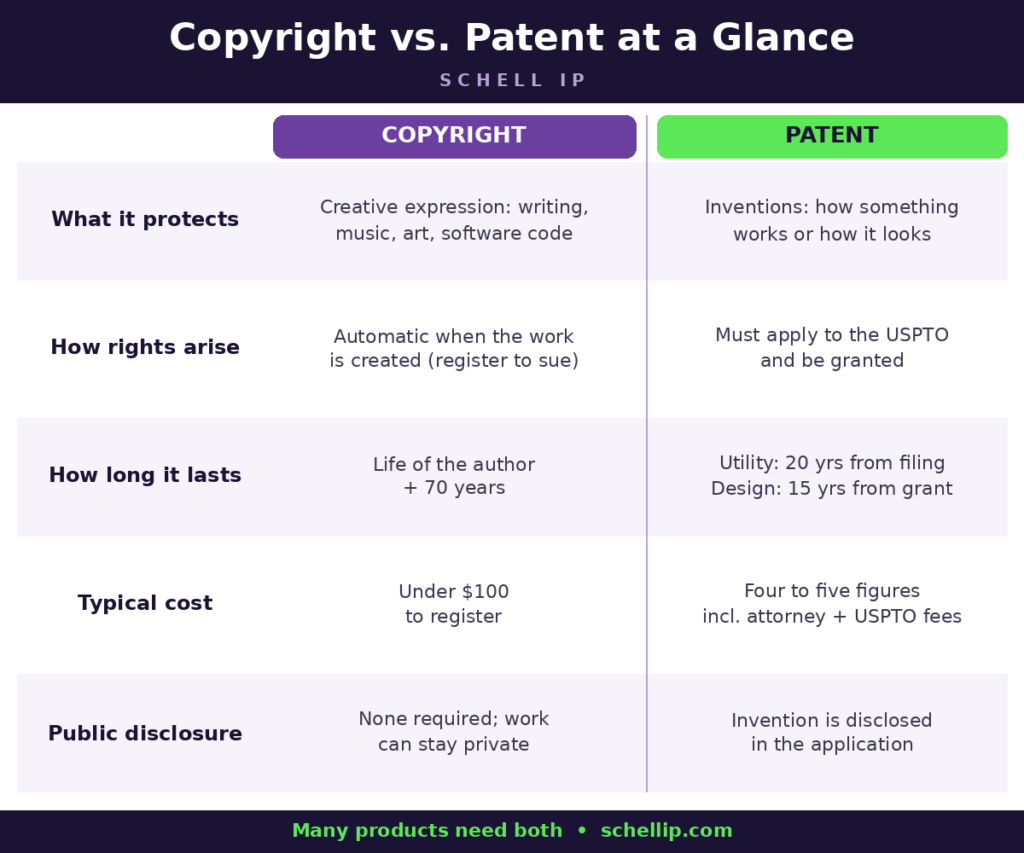
Alt text: “Chart comparing copyright vs patent protection, duration, and cost.”
When You Need Both a Copyright and a Patent
This is the part most articles skip, and it’s the situation we see most often in practice. A single product frequently contains both kinds of IP:
- Software. Your code is copyrighted automatically. But the novel technical process the code performs is only protectable by patent. A competitor can rewrite your feature from scratch without infringing your copyright; a patent is what stops them.
- Consumer products. The product’s mechanism may deserve a utility patent, its distinctive shape a design patent, and the artwork on its packaging is covered by copyright.
- Content businesses built on a tool. The tool’s utility is patent territory; everything the tool produces and everything you publish about it is copyright territory.
Choosing only one protection because it’s cheaper or faster is the mistake that surfaces later, usually during an acquirer’s diligence review or the first time a competitor clones the functional part of your product. When we scope IP strategy at Schell IP, we map which parts of the product belong to which regime before recommending anything, because the right answer is often “both, in this order.”
Design Patent vs. Copyright: The Confusing Overlap
Visual appearance is where the two regimes brush against each other. A design patent protects the ornamental design of a functional article (the look of a phone, a chair, a bottle) for 15 years. Copyright protects two-dimensional creative works like graphics, illustrations, and photographs for far longer, but it cannot protect the shape of a useful article. If the appearance of your physical product is a competitive asset, a design patent is usually the tool; if the asset is the artwork itself, copyright already has you covered. Our guide to design vs. utility patents goes deeper on the design side.
Jeff’s Take
I’ve seen the same pattern for years: people treat copyright and patent as interchangeable, or assume that whichever one they’ve heard of first is the one they need. In reality they cover completely different things, and more often than people expect, you need both. Copyright protects creative expression like books, music, art, and code, while a patent protects an invention, meaning the way something works or the way it looks. A founder who copyrights their code and stops there hasn’t protected the product at all; they’ve protected one particular way of writing it, and a competitor is free to build the same functionality from scratch.
My rule of thumb is simple: if losing the function of your product to a competitor would hurt your business, you have a patent question, and the clock on it started running the moment you disclosed the product publicly. The copyright already belongs to you automatically. The patent is the one you have to go out and get, and it’s the one with a deadline attached.
Copyright vs. Patent FAQ
Can something be protected by both copyright and patent?
Yes, and it’s common. A software product’s code is copyrighted while its novel technical process can be patented. A physical product can hold a utility patent on its mechanism, a design patent on its appearance, and copyright on its packaging artwork.
Which is cheaper, a copyright or a patent?
Copyright, by a wide margin. A patent requires drafting, filing, and examination, typically a four- to five-figure investment depending on the technology. But patent protection often is far more valuable in part because it does not require actual or intentional copying.
How long does each one last?
Copyright generally lasts the life of the author plus 70 years. A utility patent lasts 20 years from its filing date (with maintenance fees due along the way), and a design patent lasts 15 years from grant.
Does a copyright protect my idea?
No. Neither copyright nor patent protects a bare idea. Copyright protects the expression of an idea once it’s fixed in tangible form; a patent protects an invention once it’s described in a granted application. An idea only becomes protectable when it becomes one of those two things.
Do I need to register my copyright?
Your copyright exists the moment the work is created, but registration with the U.S. Copyright Office is generally required before you can file an infringement lawsuit and unlocks statutory damages. For anything commercially valuable, register it.
Not sure which protection your work actually needs? That’s exactly what a first conversation is for. Book a free consultation with Schell IP and we’ll map your product to the right protections before you spend money on the wrong one.